Table of contents
The image of an octopus, gliding silently through a meticulously crafted underwater habitat, is a staple of public aquariums worldwide. To the admiring visitor, the tank is a secure, glass-walled world. But behind the scenes, a far more cunning narrative often unfolds a silent battle of wits between aquarists and their eight-armed charges. The phenomenon of octopus escapes is not mere folklore; it is a well-documented testament to one of the most alien and profound intelligences on our planet. These are not random acts of a trapped animal, but calculated, planned, and brilliantly executed operations that challenge our very understanding of animal cognition, problem-solving, and the meaning of captivity itself.
This article delves deep into the mystery of the escaping octopus. We will explore the legendary cases that baffled scientists, deconstruct the unique biology that makes such feats possible, and analyze the profound implications of this behavior for our relationship with the animal kingdom.
A. The Houdinis of the Deep: Legendary Cases of Octopus Escapes
The anecdotal evidence for octopus escapology is vast, but a few cases have achieved legendary status, perfectly illustrating the scope of their cunning.
A. Inky The Octopus: The International Sensation
Perhaps the most famous octopus fugitive of all time is Inky, a common New Zealand octopus who resided at the National Aquarium of New Zealand in Napier. In 2016, Inky executed an escape so audacious it captured global headlines. After aquarists left a small gap at the top of his tank, likely for maintenance, Inky saw his opportunity. Biologists theorize he first climbed out of his enclosure. Then, traversing the floor, he located a 150-millimeter (6-inch) wide drainpipe that led directly to the sea. A trail of suction-cup-marked slime was the only evidence left behind, tracing a path from the tank to the drain. Inky had not merely escaped his tank; he had navigated an unfamiliar human environment, identified a specific escape route, and successfully returned to the vast ocean a journey of over 50 meters. His story remains the ultimate symbol of the octopus’s desire for freedom and its incredible problem-solving skills.
B. Otto and the Nightly Light Shows
At the Sea Star Aquarium in Coburg, Germany, an octopus named Otto developed a peculiar and costly habit. Staff would arrive in the morning to find the entire aquarium’s lighting system mysteriously short-circuited, plunging the exhibits into darkness. After repeated occurrences and costly repairs, the mystery was solved by a night watchman. Otto, who disliked the bright lights shining into his tank, had been meticulously climbing to the top of his enclosure, aiming his siphon a tube used for jet propulsion precisely at the overhead lamp, and spraying a powerful jet of water to short it out. This was not an escape in the physical sense, but a deliberate act of environmental manipulation to suit his comfort, demonstrating foresight and an understanding of cause and effect.
C. The Multi-Tank Marauder
In a more complex case at the Santa Monica Pier Aquarium in California, a two-spotted octopus demonstrated an even higher level of planning. This individual was found not just outside its tank, but in another exhibit, happily snacking on the resident spiny lobsters. The escape required navigating out of its own tank, traversing a considerable dry, terrestrial distance, and then entering a completely different aquatic system. This indicates not just a desire to escape confinement, but a specific goal-oriented mission: finding a better food source. It showcases spatial awareness, memory, and motivation that goes beyond simple curiosity.
B. The Toolbox of an Escape Artist: Anatomy of an Octopus
To understand how these escapes are possible, one must first appreciate the unique physiological toolkit of the octopus. Its body is a masterpiece of evolutionary engineering, perfectly suited for manipulation and infiltration.
A. Boneless Mastery: The Power of Hydrostatic Muscles
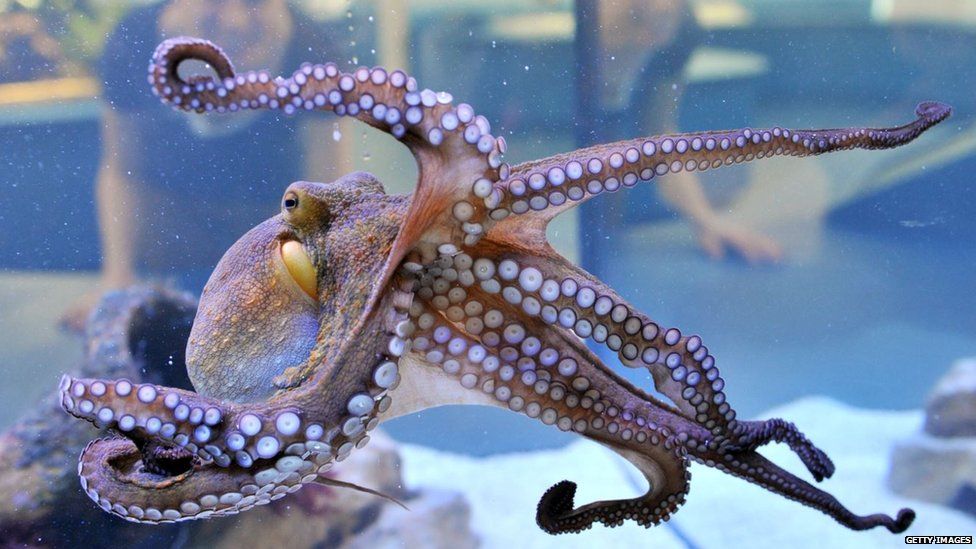
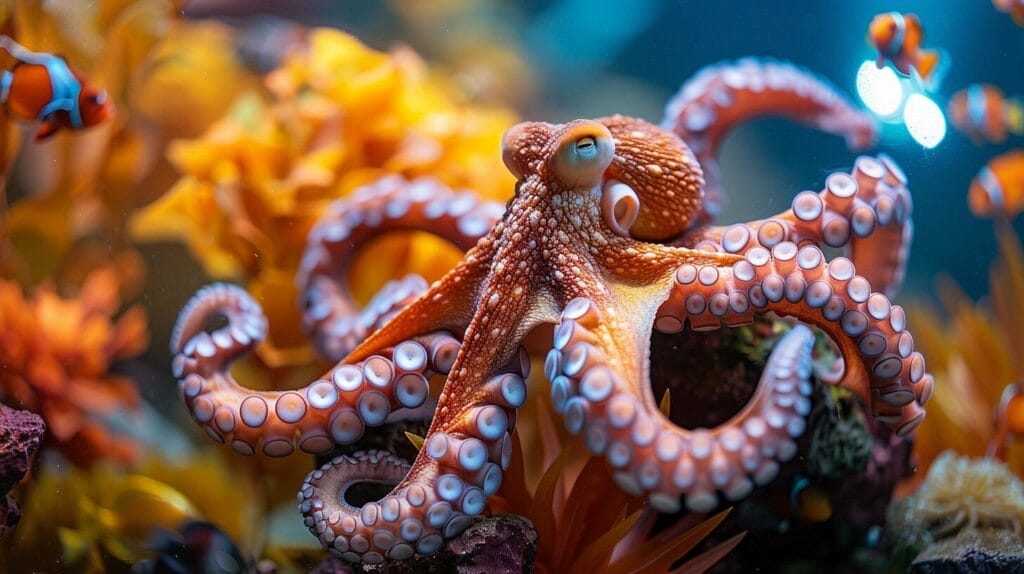
An octopus has no skeleton. Its body is composed almost entirely of muscle and connective tissue, a structure known as a hydrostatic skeleton. This allows it to contort and compress its body to an almost unbelievable degree. A common rule of thumb among aquarists is that if an octopus can fit its beak the only hard part of its body through an opening, the entire rest of its body can follow. An adult octopus can squeeze through a hole the size of a lemon or a small drainpipe, making seemingly secure lids and gaps potential exit points.
B. Sensor-Laden Arms: Thinking with Their Skin
An octopus’s eight arms are not just limbs; they are semi-autonomous sensory arrays. Each arm contains a complex nervous system, with nearly two-thirds of the octopus’s half a billion neurons located in the arms themselves. This means the arms can process information and execute complex tasks like unscrewing a lid, manipulating a latch, or feeling for weaknesses in a tank seal without direct instruction from the central brain. The hundreds of suckers on each arm are equipped with chemoreceptors, allowing the octopus to “taste” everything it touches, providing a rich, multi-sensory map of its environment.
C. Jet Propulsion and Camouflage: Stealth and Speed
For the final phase of an escape, the octopus has other remarkable abilities. Its siphon provides powerful jet propulsion, allowing for rapid bursts of speed, which can be used to propel itself out of water or across a dry surface in a pinch. Furthermore, its legendary camouflage capabilities, controlled by specialized cells called chromatophores, iridophores, and leucophores, allow it to change its color, pattern, and even texture in milliseconds. While primarily used for hunting and hiding from predators, this ability could theoretically aid in moving unseen across a multi-colored aquarium floor.
D. Problem-Solving Central: The Advanced Octopus Brain
All these physical tools are directed by a highly advanced and complex brain. Octopuses possess both long-term and short-term memory, can learn through observation, and have demonstrated the ability to use tools—such as carrying coconut shells for shelter or building walls of rocks to protect their dens. This cognitive power is the engine behind the escape. An octopus doesn’t just stumble out; it observes, learns the routines of its keepers, identifies weaknesses in its enclosure, and formulates a plan.
C. Beyond Instinct: The Cognitive Implications of Escape
The act of escaping is more than just a physical feat; it is a window into a sophisticated mind. This behavior forces us to ask profound questions about animal consciousness.
A. Evidence of Complex Cognition
The escapes detailed above are not simple reflex actions. They involve multiple steps that require different cognitive skills:
- Observation: Noticing the keeper’s routine, the gap in the lid, or the drainpipe.
- Patience: Waiting for the opportune moment, often at night when the facility is quiet and unstaffed.
- Problem-Solving: Sequencing actions, like unscrewing a lid before climbing out.
- Spatial Memory: Navigating a complex and unfamiliar environment outside the tank.
- Goal-Oriented Behavior: Escaping to reach a specific goal, like the ocean or a tank with better food.
This sequence aligns with what scientists define as complex, planned behavior, a sign of higher intelligence.
B. Boredom, Curiosity, and the Question of Welfare
Why do they do it? Instinct for foraging is one driver, but many scientists believe boredom and intellectual curiosity are significant factors. Octopuses are inherently curious and exploratory animals. In a barren tank with no stimulation, this natural drive may manifest as escape attempts. They are known to play, investigate novel objects, and can even exhibit individual personalities some are shy, while others are bold and adventurous. An escape attempt could be the ultimate expression of an octopus’s need for mental stimulation and environmental control, raising serious questions about the ethics of keeping such intelligent creatures in captivity without providing adequate enrichment.
C. The Alien Nature of Their Intelligence
It is crucial to remember that octopus intelligence evolved entirely separately from our own. Our last common ancestor was a primitive, worm-like creature over 600 million years ago. Their nervous system is distributed, their perspective is that of a soft-bodied, camouflaging predator. This means their problem-solving process is fundamentally alien. They don’t think like a mammal or a bird. Understanding their escapes gives us a rare glimpse into a completely different evolutionary path to intelligence.
D. The Aquarist’s Challenge: Fortifying the Octopus Enclosure
In response to these clever escape artists, aquarium professionals have become experts in “octopus-proofing,” a constant and evolving challenge.
A. The Lid-Locking Arms Race
The first line of defense is a secure lid. But a simple lid is not enough. Aquarists have learned that lids must be heavy, often weighted down, and secured with complex latches or even locks that cannot be manipulated by strong, dexterous arms. Some facilities use spring-loaded lids or ones with smooth, undercut edges that provide no grip for suckers.
B. Containing the Hydrostatic Houdini
Since octopuses can squeeze through tiny gaps, tank design is critical. All openings, including pipe inlets, overflow holes, and filter gaps, must be screened with very fine mesh. Seals around the top of the tank and between glass panels must be perfectly flush, with no gaps for an exploratory arm to pry open.
C. Environmental Enrichment: The Best Defense
Perhaps the most effective strategy is not just physical security, but mental engagement. A bored octopus is an escape artist in the making. Modern aquariums provide extensive enrichment for their cephalopod residents:
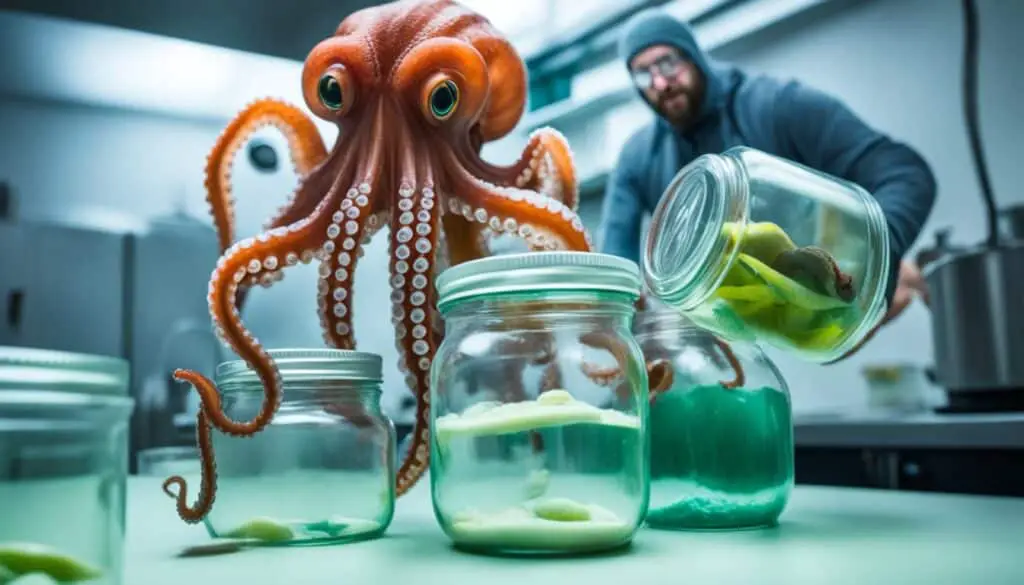
- Puzzle Feeders: Jars with screw-top lids, Lego boxes, or acrylic puzzles containing food.
- Novel Objects: Introducing new items like Mr. Potato Head, plastic toys, or textured balls for them to investigate.
- Habitat Variety: Creating complex environments with rocks, caves, and shifting substrates for them to rearrange.
- Social Interaction: Some species enjoy controlled interactions with their keepers, such as being shown different objects or even engaging in gentle “play.”
A mentally stimulated octopus is less likely to devote its considerable intellect to plotting a great escape.
E. The Ethical Depths: What Escapes Teach Us About Captivity
The recurring narrative of the escaping octopus forces a critical ethical examination.
A. The Debate on Intelligent Life in Tanks
Is it ethical to keep an animal with proven complex cognitive abilities, a clear sense of curiosity, and a demonstrable desire for freedom in a confined space, no matter how well-designed? For some, the educational and conservation value of aquariums justifies it. For others, the escapes are a clear message that these particular beings are unsuited for a life of captivity. This debate is at the forefront of modern zoo and aquarium ethics.
B. Pushing the Boundaries of Marine Science
On the other hand, studying octopuses in captivity has been instrumental in uncovering the very intelligence we now marvel at. Their escapes are a form of data, teaching us about their capabilities in a way that observing them in the open ocean rarely can. The challenge is to find a balance to create captive environments that are not just secure, but also respectful and enriching enough to satisfy their complex minds.
C. A Symbol of the Wild’s Unbreakable Spirit
On a symbolic level, the escaping octopus has become an icon. It represents the indomitable, wild spirit that refuses to be fully tamed or understood. In a world of shrinking wild spaces, the story of an octopus outsmarting its human captors to return to the sea is a powerful and hopeful narrative. It reminds us that nature, in all its forms, is resilient, ingenious, and full of surprises.
Conclusion: More Than Just an Escape
The mystery of the octopus escape is far more than an amusing anecdote or a logistical headache for aquarists. It is a profound lesson in biology, cognition, and ethics. Each suction-cup-marked trail leading from a tank is a testament to an intelligence that is both deeply familiar in its complexity and profoundly alien in its execution. As we continue to study these remarkable creatures, we are not just learning how to build better lids; we are being forced to expand our definition of mind, to reconsider the needs of the animals we keep, and to acknowledge the wild, untamable genius that lurks in the depths of the sea and sometimes, in the tanks we build to contain it. The great escape is never just about freedom; it’s a conversation, and the octopus has a great deal to say.